

Front-lit
The letter faces glow evenly across their whole surface – the clearest long-distance read for frontages and entrances, legible even in daylight.
See matching styles
Front-lit, halo, side-lit, double-sided or LED neon: the type of illumination determines how your sign looks at night and how legible it is from a distance. Here you can compare all variants – with construction, light effect, suitable mounting and tips for making the right choice.
Drag the slider or tap the switch to see how each construction looks by day and by night.
The letter faces glow evenly across their whole surface – the clearest long-distance read for frontages and entrances, legible even in daylight.
See matching styles

Light shines backwards onto the wall and draws a soft halo around each letter while the face stays solid – understated and elegant, ideal for receptions and premium frontages.
See matching styles

Only the letter edges glow while the face reads as solid by day. A fine outline of light that sharpens the silhouette after dark.
See matching styles

Face and back light up together: crisp, readable letters plus a halo on the wall. The strongest light effect for brands that want to stand out.
See matching styles

Solid acrylic letters glow through face and edges at once – a fully luminous body that works especially well at small sizes and indoors.
See matching styles

Light boxes and projecting signs lit on both faces, mounted at right angles to the frontage – visible to passers-by from both directions.
See matching styles

Flexible LED neon lines on acrylic trace your lettering or logo as a glowing line – the classic neon look, energy-efficient, shatterproof and dimmable.
See matching styles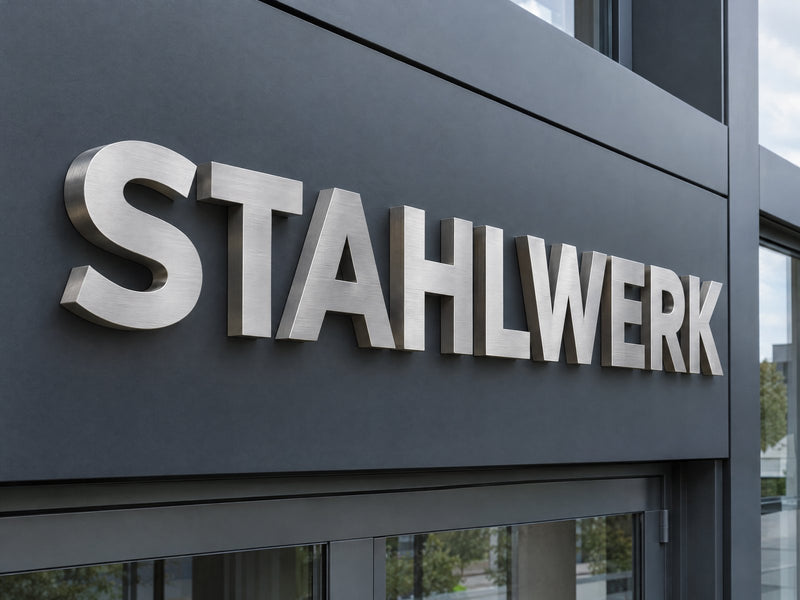 Example: Fabricated metal, brushed
Dimensional metal letters without lighting – depth, shadow and material do the talking, with no power supply needed.
See matching styles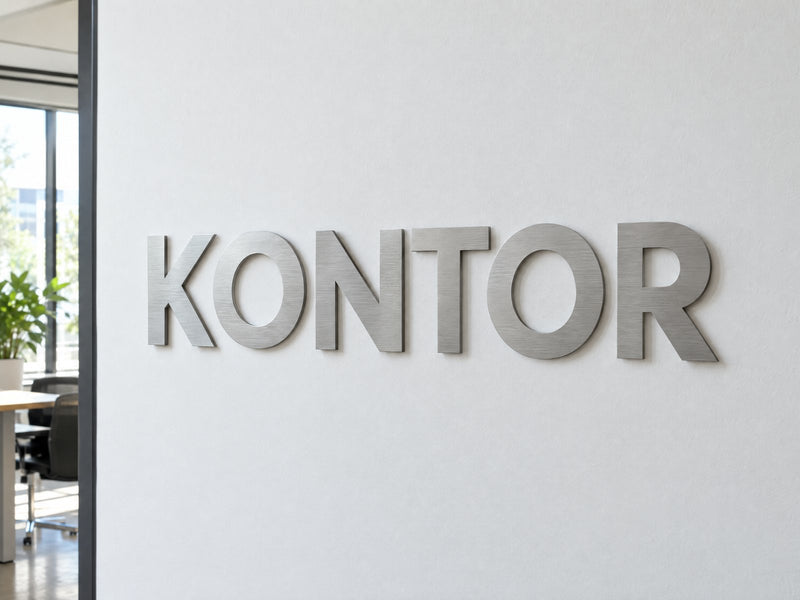 Example: Flat-cut metal, brushed
Flat, precision-cut letters and panels in metal, acrylic or aluminium composite – slim, timeless and quick to install.
See matching stylesWhether a sign looks refined by day, stays legible from 50 metres at night or quietly enhances a reception area depends above all on the type of illumination. With illuminated letters and illuminated signage, the key question is which side the light comes from: the front, the back, the sides or through a printed surface. Here you can find out how each variant is built, how it looks and which application it suits.
With front-lit letters, the LEDs sit inside a closed letter body and the face is made of opal acrylic. The light shines evenly forwards while the side walls (returns) stay dark. This construction is the standard for façades because it has the greatest long-distance impact – the lettering stays clearly legible even from far away.
Front-lit letters come in a classic version with a trim cap, a rimless version for a pared-back look, or with a vacuum-formed, domed face for a sculpted effect. You can find an overview on the Front-lit letters page. Light boxes are essentially front-lit too: here a printed surface is lit across its whole area.
With back-lit letters, the face is closed, usually in painted aluminium or stainless steel. The LEDs shine backwards onto the wall, creating a soft ring of light around every letter – known as halo lighting. The lettering itself appears as a silhouette against the light.
Halo letters look premium and do not dazzle. They are the preferred solution for reception areas, hotels, medical practices and law firms. They need a wall clearance of about 3–5 cm – which is why back-lit letters are always mounted on standoffs. The effect works best on light, smooth walls. Find out more on the Acrylic back-lit letters & halo logos page.
A front and back-lit letter shines both forwards and backwards. The opal face ensures legibility, while the translucent back creates the halo. The result looks three-dimensional and especially striking – ideal for restaurants, bars, gyms and anyone who wants to stand out in the evening. Face and halo can even be made in different light colours. Details on the Front & back-lit letters page.
With side-lit acrylic letters, the face is covered and the light escapes only at the edges. The lettering shows as a fine line of light, and by day the face displays your chosen colour or a metal finish. If the face is lit as well, the letter is called front and side-lit – the whole letter then looks like a body of light.
These variants are particularly suited to interiors, shop windows and sheltered outdoor areas. As no metal body is needed, smaller lettering is easy to produce too. See Channel letters and Acrylic & flat letters.
Double-sided signs have two illuminated faces and are mounted at right angles to the façade, so passers-by see your logo from both directions. Typical examples are illuminated projecting signs and double-sided light boxes in pedestrian zones.
With LED neon signs, it is not a surface that glows but a line. Flexible LED neon tubes are shaped and mounted on acrylic. This creates the classic neon look – more modern, more economical and more robust than glass neon. LED neon lights up instantly and evenly. A dimmer and remote control are included with every sign. With RGB versions, the whole sign changes colour together.
Not every sign has to light up. 3D letters in stainless steel or painted metal make their impact through depth and shadow, flat metal letters through precision and material. If needed, they can be lit with spotlights. Moss logos and fascia signs also work without their own illumination.
| Illumination type | Light effect | Long-distance impact | Typical mounting | Ideal for |
|---|---|---|---|---|
| Front-lit | glowing face | very high | direct, standoffs, rail | Façade, retail |
| Back-lit (halo) | ring of light on the wall | medium | standoffs only | Reception, hotel, practice |
| Front & back-lit | face + halo | high | standoffs | Hospitality, bars |
| Side-lit | glowing outline | medium | direct, standoffs, rail | Interiors, studios |
| Front & side-lit | whole letter glows | high | direct, standoffs, rail | Shops, shop windows |
| Double-sided | two glowing faces | high (from the side) | wall bracket, suspension | Pedestrian zone, old town |
| LED neon | glowing line | medium to high | standoffs, suspension, stand | Café, bar, event, home |
| Non-illuminated 3D/2D | material and shadow | daylight | direct, standoffs | Reception, practice, office |
A sign is seen in daylight most of the time, so it pays to think about how it looks when switched off. By day, front-lit letters show the colour of their acrylic face, halo letters their painted or metallic face, and side-lit letters their covered face colour. With a special day/night film, a face can look dark by day and glow white at night – popular for black logos. That is why the Sign type guide shows every version both switched on and switched off.
All our illuminated signs use LED technology. LEDs reach full brightness instantly, produce little heat and use only a fraction of the energy of classic fluorescent tubes or glass neon. Depending on the sign type, the power supply is concealed in the wall, in a mounting rail or behind the sign. With a timer or a dusk sensor, your illuminated signage can switch on and off automatically.
If your sign needs to be read from the street, a front-lit or combined version is usually the best choice. As a rule of thumb, allow about 10 cm of letter height per 10 m of distance. For reception walls, on the other hand, halo or side-lit letters are often enough.
Halo effects need a light, ideally smooth wall. On dark facing brick or coarse render, a front-lit letter is often more effective.
If your logo should appear in its colours at night, front-lit is ideal. If you want elegance rather than signal effect, halo or stainless steel is the better fit.
Warm white looks inviting and suits hospitality, hotels and wood. Cool white looks clear and modern. Coloured light adds accents – for example a white halo behind a coloured face.
Not sure? Send us your logo – in a free design preview we will show you how your sign looks with the right illumination. You can find an overview of all versions in the Sign type guide, and everything about fixing on the Mounting methods page.
Front-lit letters have the greatest long-distance impact because the whole face glows. For façades facing a street, they or front & back-lit letters are usually the best choice.
With halo letters (back-lit letters), the face is closed and the light shines backwards onto the wall. This creates a soft ring of light around every letter.
Yes. Back-lit letters are always mounted on standoffs about 3–5 cm in front of the wall, otherwise the ring of light cannot form.
On light, ideally smooth surfaces. On dark facing brick or coarse render the effect is weaker – a front-lit letter is often more effective there.
Front-lit letters glow across the whole face, side-lit letters only at the edges. Side-lit letters look more understated and show their face colour by day.
Yes. Warm white, cool white and coloured light are all possible. With front & back-lit letters, the face and halo can even have different light colours.
With RGB, the whole sign changes colour together, controlled by the remote. Individual letters do not light up in different colours.
LEDs need only a fraction of the energy of classic fluorescent tubes or glass neon. With a timer or dusk sensor, the sign only lights up when it is needed.
Not sure which illumination suits your logo?Send us your logo and a photo of the location – a free design preview shows you how it looks lit.
Request a free design preview