
Sign type · Made to order
Projecting Signs for Shop Fronts – Illuminated or Non-Illuminated
Mounted at right angles to the wall – so your shop is visible from down the street, not just from the doorstep.
- Free design preview
- No-obligation quote
- Production only after your approval
Certified & tested


What makes Projecting Signs work
Projecting signs (also called blade signs) sit perpendicular to the facade and can be read from both directions of foot traffic. For shops on high streets and side streets they are often the most important sign of all – people see it before they reach your window.
We make projecting signs illuminated or non-illuminated: as an LED light box, with raised letters or as a printed panel, to match your logo and the building. Send us your logo and a photo of the frontage and we’ll create a free design preview.
Typical uses
Which parts light up?
What lights up on projecting signs, what stays printed or unlit – and from which size. Your free design preview shows it for your own logo.
As a lightbox
The whole face glows evenly from inside, on both sides of the projecting sign.
With cut-out lettering
Only your lettering and logo let light through; the aluminium face around them stays dark. Especially refined at night.
Non-illuminated
A printed or lettered panel on a wall bracket, visible by daylight or a separate spotlight.
Dark print areas
Black or very dark areas in the artwork let almost no light through and read as unlit at night. We plan for this in the design preview.
Why choose this sign type
Readable from both sides
Two faces in one sign – double the visibility for passing trade.
Illuminated or not
LED light box for night-time visibility, or a classic sign with bracket.
Weatherproof
Aluminium, acrylic and UV-stable print – built for the outdoors.
Custom shape
Round, rectangular or cut to your logo shape – wall bracket included.
Examples & inspiration
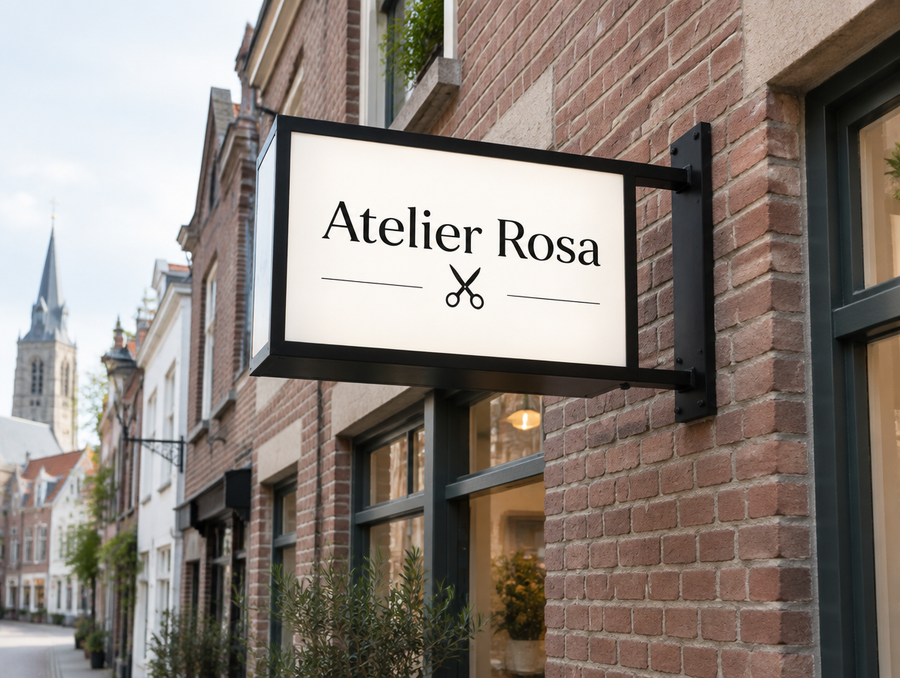
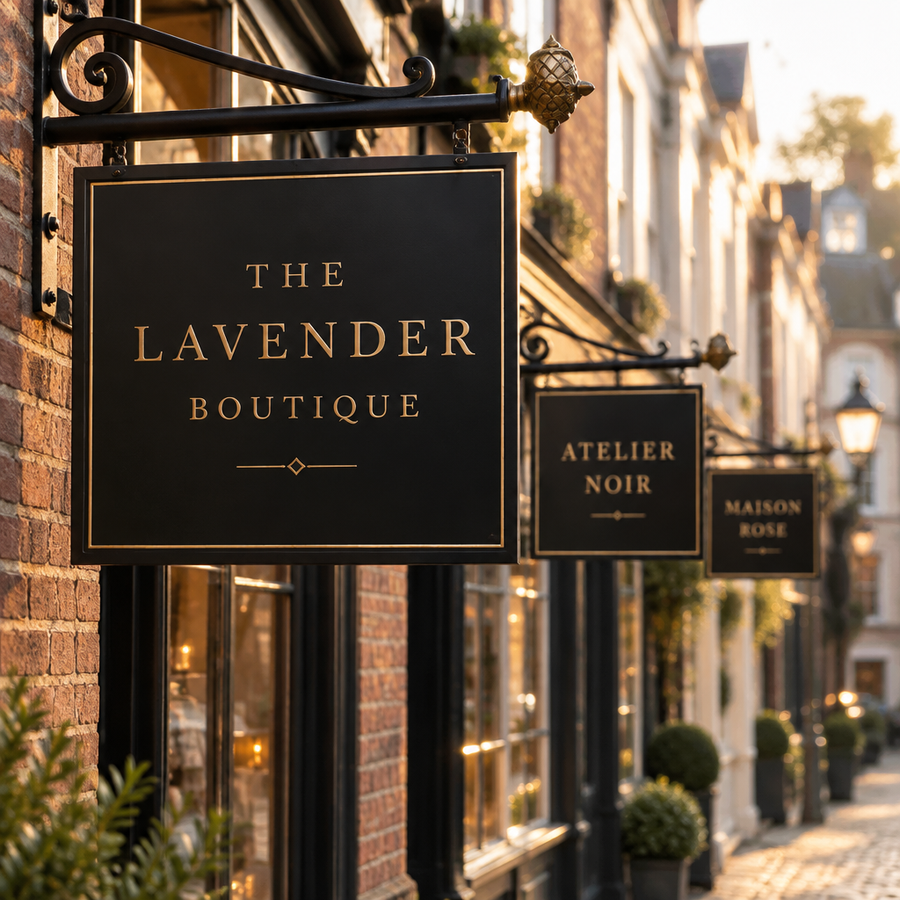
How would this look with your logo?Send your logo and a photo – you'll get a free design preview on your own building.
Free design previewWhat is a projecting sign?
A projecting sign sits at right angles to your shop front and reads from both directions. You'll also hear it called a hanging sign, a projection sign or, in the US, a blade sign. The job is the same whatever the name: to be seen by people walking along the pavement.
That matters more than it sounds. From the pavement, your fascia is seen at a steep angle and almost disappears. A projecting sign faces the flow of foot traffic, so it's often the first thing passers-by notice about your shop, long before they reach the window.
Four ways to build a projecting sign
| Construction | After dark | Works well for |
|---|---|---|
| Double-sided LED lightbox | The whole face glows evenly. The brightest option. | Cafés, pharmacies and shops on busy high streets |
| Fret-cut aluminium tray | Only the cut-out lettering and logo glow; the face stays dark. Refined and calm. | Barbers, boutiques, cafés with a strong brand |
| Plate sign on a steel bracket | Non-illuminated, lit by a spotlight if needed. | Conservation areas, clinics, solicitors, guesthouses |
| Contour-cut to your logo shape | Illuminated or not, depending on the build. | Brands with a strong symbol: a pretzel, a coffee cup, scissors |
Our rule of thumb: on a bright high street you need a lightbox to compete with shop windows and street lighting. On a quiet side street a fret-cut tray often looks stronger because it doesn't glare. Where the local authority won't allow illumination, a painted plate on a traditional bracket is still the classic.
Do you need planning permission for a projecting sign?
Often, yes. Illuminated projecting signs usually need a permit from your local planning authority, and in a conservation area or on a heritage-listed building you should always check first. The authority also sets the minimum clearance above the pavement and how far the sign may project. Call the planning team before you order.
- Clearance: your local authority sets the minimum height above the pavement. Plan the fixing height around it.
- Projection: 50–90 cm is typical. Over the public highway, a separate licence may be needed.
- Illumination: most consent questions are about light: brightness, whether it's internally lit, and opening hours.
- Conservation areas and heritage-listed buildings: expect rules on size, materials and lighting; some only accept externally lit signs.
- Landlord: as a tenant, you need your landlord's consent, because the bracket is drilled into the building.
- Documents: planning authorities usually want a drawing with dimensions, the fixing height and a photo of the frontage. We supply a dimensioned drawing and a visual on your own photo.
Double-sided design: getting both faces right
A projecting sign has two faces and both have to read correctly. Simply mirroring the artwork rarely works: a logo with an arrow, a script or a figure facing one way would read backwards on the other side. We set up each face separately so your logo reads the right way from both directions.
Shape matters too. A round sign reads the same from both sides; a portrait format leaves more room for a name set over two lines. The bracket and cable enter on the wall side, and we plan for that so the fixing never cuts into your logo.
Installation and power
The sign is fixed with a wall bracket anchored into brick or concrete. On insulated render (external wall insulation) you need special fixings that carry the load through the insulation into the masonry – that's one for a professional installer. Illuminated signs are connected to the mains, always by a qualified electrician.
Your sign arrives with the bracket, fixings and installation instructions. If you don't have an installer, we can help you find one near you.
It pairs well with a lightbox sign above the entrance, illuminated letters on the fascia or a complete shop front sign.
Technical details
| Material | Aluminium, acrylic, stainless steel bracket |
|---|---|
| Illumination | Optional internal LED |
| Faces | Double-sided |
| Use | Outdoor, weatherproof |
| Mounting | Wall bracket, drilled fixing |
| Power | Mains connection for illuminated version |
| Certification | CE, TÜV, UL, RoHS-compliant |
How your request works
- 1
Send logo & photo
Upload your logo and describe size, location and preferred material – a photo of the wall or frontage helps us plan.
- 2
Design preview & quote
You receive a free digital preview of your sign and a specific quote – with no obligation.
- 3
Approval & production
Production starts only once you approve. Your sign arrives safely packed with fixings included.
Projecting Signs – frequently asked questions
Do I need planning permission for a projecting sign?
How far does it project from the wall?
Can it light up at night?
How is it fixed?
Can I have it in my logo shape?
Is a hanging sign the same as a projecting sign?
Do both sides read the same?
Do you install the sign?
Guides: installation, quality and FAQs
All guidesProjecting Signs for your industry
Other sign types

Projecting Signs: ready to start your project?
Send us your logo, dimensions and a photo of the location. You'll get a free design preview and a quote – nothing is made until you approve.